



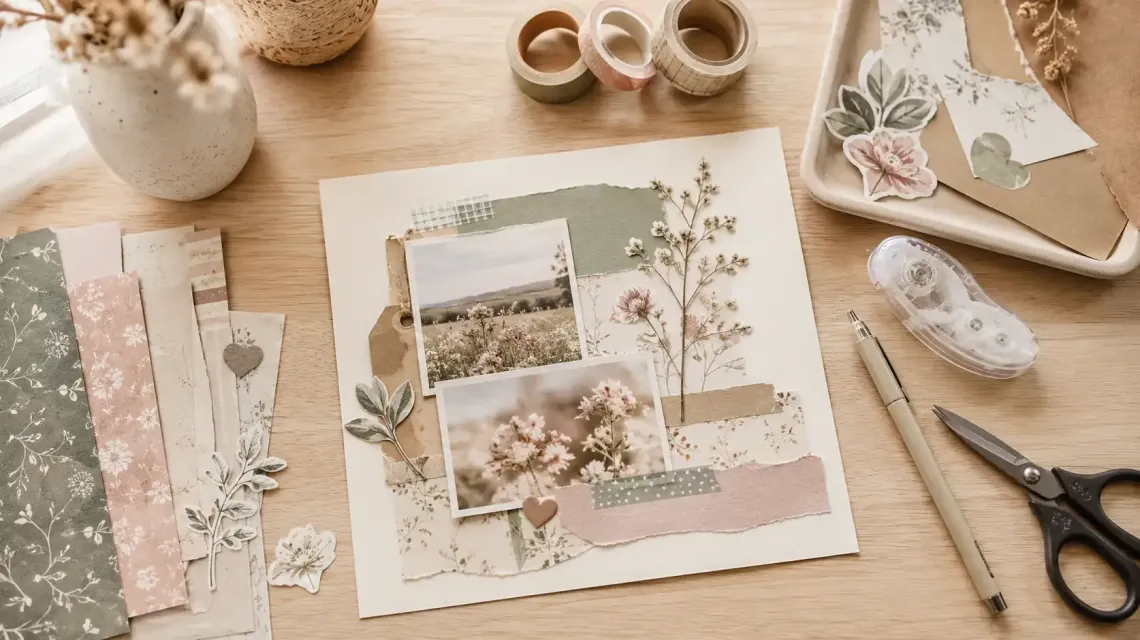
Scrapbooking for Beginners: How to Create a Beautiful Page with Paper, Stickers, and Washi Tape
You do not need innate artistic talent. You need curiosity, a few well-chosen materials, and permission to play.
A scrapbook page is not a project to be completed. It is a space to live in — a place where you attach memories, words, and colors until the page begins to look like you.
Scrapbooking has old roots — people have been keeping tickets, photographs, and small meaningful objects in albums since the 19th century. But its current form, with decorative paper, washi tape, stickers, and ephemera, is one of the most accessible and therapeutic forms of creativity you can practice at home.
You do not have to be an artist. You do not need an impressive collection of materials. You need a sheet of cardstock, a few decorative elements, and the desire to arrange things until the result makes you happy.
In this guide, we explain step by step how to build a balanced and beautiful page — from choosing the color palette to the final decorative accent added with washi tape. Simple, practical, and without complicated jargon.
Basic materials — what each one does
Before you start your first page, it is useful to understand the role of each material in the composition. Scrapbooking works on the principle of layers — each element adds a new dimension, from the background to the final detail.
The foundation of the page. Usually 30x30 cm or A4, in neutral colors or in the dominant tone of your palette. Everything placed on top relates to it — choose a color that allows the other elements to breathe.
Patterned sheets — stripes, polka dots, florals, textures, watercolors. They can be cut, torn (torn edges have an appreciated organic aesthetic), and glued in layers. This is the element that gives the page its thematic character.
Small printed cutouts — tags, tickets, labels, vintage illustrations, floral frames, decorative stamps. They add story and visual depth. These are the elements that make a page feel curated and personal, not generic.
Quick and flexible accents. They can be repositioned before final adhesion. There are transparent stickers (they blend into any palette), foil-style stickers (gold, silver), and illustrated stickers. Use them with restraint — less is more.
Decorative tape made from rice paper, partially transparent and repositionable. It creates borders, separates areas, anchors elements, or simply adds color and rhythm. It is one of the most versatile tools in scrapbooking.
Brads, metal eyelets, buttons, small paper flowers, adhesive pearls, tiny bows. They add texture and relief to the page. Used strategically in one or two spots, they create a visual jewelry effect on the page.
The beginner material rule: Do not buy everything during your first session. Start with a scrapbook paper pad with coordinated patterns, one roll of washi tape, a few sheets of ephemera, and a small sticker set. Coordinated materials from one collection are already designed to work together — removing one of the biggest difficulties for beginners.
Step 1: Choose the color palette
The most common mistake beginners make in scrapbooking is using too many colors. The result looks crowded and tiring to the eye, even if each individual element is beautiful. Color coherence is the secret behind pages that look professional.
The 3-color rule
Choose a dominant color (the most present one, usually the background or the main paper), a secondary color (complementary or close in tone), and an accent color (used sparingly to draw the eye). That is enough.
If you are working with a paper pad from a themed collection, the palette is already solved — the designers have coordinated the colors for you. Choose 3-4 matching sheets from the collection and build the page around them.
The neutral background trick: If you are not sure which dominant color to choose, start with cream or warm white cardstock. On a neutral background, any combination of decorative papers will look balanced. A neutral background is every beginner’s safety net.
Step 2: Set the focal point
Every scrapbook page needs a main element — a point where the eye stops first. This can be a photograph, a large title, a special illustration, or a more elaborate ephemera arrangement. The rest of the page is built around it.
How to choose the focal point
- A photograph — the most classic focal point in traditional scrapbooking; place it slightly outside the geometric center of the page, following the rule of thirds
- A large typographic title — cut-out letters, large text stickers, or handwriting with a marker; it works beautifully in journaling and on pages without photographs
- A special ephemera element — a vintage botanical illustration, an elaborate decorative tag, or a printed floral frame; place it centrally and build around it
- A piece of paper with a strong pattern — a square or rectangle with a dramatic print, placed off-center, instantly becomes a focal point
Avoid having two focal points with the same visual strength on the same page. The eye does not know where to stop, and the page feels disoriented. If you want to highlight two elements, make sure one is clearly more dominant than the other.
Step 3: Layer the elements
Layering is the technique that turns a flat page into a composition with depth and character. Instead of gluing each element directly onto the base cardstock, you place them in layers — some partially covered by others, some slightly tilted, some with organically torn edges.
-
1The background layer — the large paperPartially cover the base cardstock with one or two sheets of decorative paper. It does not need to cover the entire surface — the visible cardstock areas are part of the composition. You can place the paper straight or slightly tilted by 2-3 degrees.
-
2The middle layer — washi strips and ephemeraAdd strips of washi tape as borders or separating elements. Place the first ephemera pieces — tags, small illustrations, frames. Overlap some of them partially to create depth. At this stage, nothing is glued permanently — experiment with loose positions first.
-
3The main layer — the focal pointPlace the photograph, main illustration, or large title. This is the moment when the page begins to make sense. Check that the focal point is clearly visually dominant and that the surrounding elements support it, rather than compete with it.
-
4The detail layer — stickers and small accentsAdd the stickers, decorative petals, and small 3D accents. These are the final elements added, and their role is to complete, not overcrowd. If you feel the page looks good without the sticker you are holding in your hand, do not add it.
The photographer’s trick: Before gluing anything down, take a photo of the page with your phone. Looking at it on the screen, in miniature, you will immediately notice whether something is unbalanced, too crowded, or missing. The screen makes it smaller and more objective — your eyes get used too quickly to what is on the physical page.
Step 4: Add the text
Text is the voice of your page. It can be a date, a quote, a handwritten memory, a thematic title, or simply a word that captures the mood of that moment. In scrapbooking, text is not mandatory — but when it is present, it should be visually integrated, not thrown onto the page.
Types of text in scrapbooking
The most visible text element. It can be made from cut-out letters, alphabet stickers, an ink stamp, or handwriting with a liner or marker. Its size should be significantly larger than any other text on the page.
The narrative text — the story behind the page. Handwritten on a separate piece of paper (a tag, a small sheet), then attached as a design element. Imperfect handwriting is more authentic and more beautiful than any printed font.
A verse, a phrase, a meaningful word. It can be written on washi tape, on a strip of kraft paper, or on a decorative tag. Short quotes work better than long ones — they should be read at a glance.
The month, the year, the place — small pieces of information that anchor the page in time. Write them discreetly with a fine liner, in a corner or on a small tag. They do not need to be large or highly visible — their role is to be discovered, not displayed.
The most common mistake in scrapbooking is writing directly on the base cardstock and only then building the page around it. Always write the text on separate elements (tags, paper strips, small cards) that you attach later. This way, you can reposition, correct, or replace the text without compromising the entire page.
Step 5: Visual balance and the rule of empty space
This is the step most beginners skip — and that is why their pages feel crowded, no matter how beautiful the individual elements are. Visual balance does not mean symmetry. It means the eye moves comfortably across the page, without feeling trapped or overwhelmed.
White space — the most important invisible element
In graphic design, white space (or negative space) is the area intentionally left empty. In scrapbooking, it is the area of cardstock or paper where you have not attached anything. Far from being a mistake, empty space is what gives the page breathing room and makes the existing elements stand out.
When to stop
This may be the hardest thing to learn in scrapbooking: knowing when a page is finished. A good sign is when you feel the urge to add one more element, but you stop and ask yourself: “What purpose does it serve?” If you do not have a clear answer, the page is probably already complete.
A page with 10 intentionally chosen elements is more beautiful than one with 30 elements added out of fear of empty space. Empty space is not a mistake. It is a design decision.
Start without the pressure of perfection
Your first scrapbook page will not be the most beautiful one you will ever make. But it will be the most important — because you will finish it. And in that moment, you will understand something no guide can truly explain: that the process itself is more valuable than the result.
Scrapbooking is meditative. There is something deeply calming about cutting paper, arranging small pieces on a page, pulling a strip of washi tape, and watching something that did not exist before take shape. It is not efficient. It does not produce anything strictly useful. And that is exactly why it is so valuable.
Start with a simple page. One photograph or one memory. Three colors. A few elements. Washi tape along one edge. One handwritten word. And that is enough.
Do not compare your work with what you see on Pinterest or Instagram. Those pages are made by people with years of practice and collections of materials built over time. You are on page one — and page one is exactly where you are supposed to be.
Everything you need for your first page
Discover decorative scrapbook paper, washi tape in dozens of designs, stickers, ephemera, and journaling accessories in the Solideea catalog — carefully chosen materials for those who want to start beautifully.
Explore the Solideea catalog →
Leave a Comment