



How to Build Your Handmade Brand’s Visual Identity from Scratch
Beautiful products deserve a visual presence to match—without a designer or a large budget, but with plenty of intention.
A beautiful product deserves to be seen. Visual identity is the lens through which people perceive it—before holding it, using it or deciding whether to buy it.
Almost every small maker recognizes this situation: the products are good, perhaps even exceptional, but the visual presentation jumps from one font to another, the colors differ between Instagram and the physical label, and the packaging has nothing in common with the thank-you card. The brand looks like a collection of rushed decisions rather than an identity built with intention.
The good news is that visual identity is not reserved for large brands with enormous budgets. At its core, it is a set of coherent decisions—the same colors, the same fonts and the same visual communication style, used consistently until they become easy to recognize. Any small maker can make these decisions today without hiring a designer.
The Color Palette—the Foundation of Your Brand
Color is the first thing the brain processes in an image—before shape, text or any other detail. That is why your color palette is one of the most important decisions you make when building your visual identity.
How Large Should the Palette Be?
The golden rule for small handmade brands: a maximum of 3–4 colors. Choose one dominant color, one secondary color, one accent color and, optionally, a neutral tone such as white, cream or warm gray. More than that creates visual chaos rather than richness.
- The dominant color — appears on packaging, labels and Instagram backgrounds; it is the color people will associate with you
- The secondary color — complements the dominant color and appears in details, borders and card backgrounds
- The accent color — used sparingly to draw attention to buttons, seals or a decorative element
- The neutral tone — the cream, white or kraft tone on which everything rests; it gives the entire system room to breathe
How to Choose the Right Colors for Your Handmade Brand
Do not choose colors at random or copy someone else’s palette. Start with your products: which colors appear in them naturally? A ceramic artist working with sage green and terracotta glazes already has a palette—they simply need to recognize and formalize it.
Sage green, warm cream, kraft brown and pale terracotta. This palette works beautifully for candles, wooden decorations and ceramic pieces with natural glazes.
White, light gray, matte black and a single warm accent such as mustard or caramel. Suitable for handmade jewelry with geometric designs and white ceramic objects.
Dusty pink, lavender, cream and delicate gold. A good match for decorated candles, semiprecious-stone jewelry and textile decorations.
Kraft, dark brown, ochre and deep green. This palette is especially cohesive with natural packaging—everything leaving the workshop appears to belong to the same visual world.
Practical exercise: Open Pinterest and create a private board with 20–30 images that appeal to you visually and suit your products. View them together and identify the colors that appear most often. That is your natural palette—not one you invented, but one you discovered.
Typography—the Visual Voice of Your Brand
After color, typography communicates more about a brand’s personality than almost any other element—even before you actually read the text. An elegant serif typeface conveys something different from a geometric sans serif, which in turn feels different from a calligraphic font.
The Two-Font Rule
For a small handmade brand, two fonts are more than enough. Use one for headings and one for body text. That is all. When used consistently, these two typefaces can become as recognizable as your color palette.
-
1The Primary Font—for Headings and the Brand NameChoose something with character: an elegant serif such as Lora, Playfair Display or Cormorant; an italic serif such as Libre Baskerville Italic; or a sans serif with personality such as DM Sans or Jost. This is your brand’s “voice,” so it should be recognizable and suit the aesthetic of your products.
-
2The Secondary Font—for Body Text, Descriptions and LabelsIt should remain highly legible at small sizes. A clean sans serif such as DM Sans, Inter or Karla works in most cases. It should sit comfortably beside the primary font without competing for attention.
-
3Test the Combination on a Real LabelBefore deciding, print a test label using your chosen font combination. What looks good on a screen may appear different when printed on kraft paper or an adhesive label. A physical sample will tell you more than the screen.
Avoid highly decorative fonts on small labels—at 8–10 pt they become difficult to read and create frustration. Reserve elegant cursive fonts for larger headings, where they have room to breathe and be appreciated.
Consistency Across Packaging, Labels and Social Media
This is where many small makers lose consistency. Labels are created in one program, Instagram posts in another, and the supplier’s packaging does not match either. The result is a brand without a clear identity.
Consistency does not mean that everything must be identical. It means that everything should be recognizable as belonging to the same visual world. A customer who has seen an Instagram post should receive a package and immediately think, “Yes, this is the brand I know.”
Your Brand’s Visual Touchpoints
Each of these touchpoints is an opportunity either to reinforce your visual identity or to dilute it. The choice is yours—but making it intentionally requires a clear system.
Labels—the Link Between the Physical and Digital Worlds
Your product label is the one element that exists simultaneously in the physical and digital worlds—it appears on the product, in Instagram photographs and in the customer’s unboxing photo. In many respects, it is the most important tangible visual element of your brand.
- Use kraft labels with rounded corners for a warm, natural aesthetic that complements sustainable packaging
- Keep the information on the label minimal—the brand name, product name and perhaps a short tagline
- Apply the logo or initials with a stamp—you do not need professionally printed labels to get started
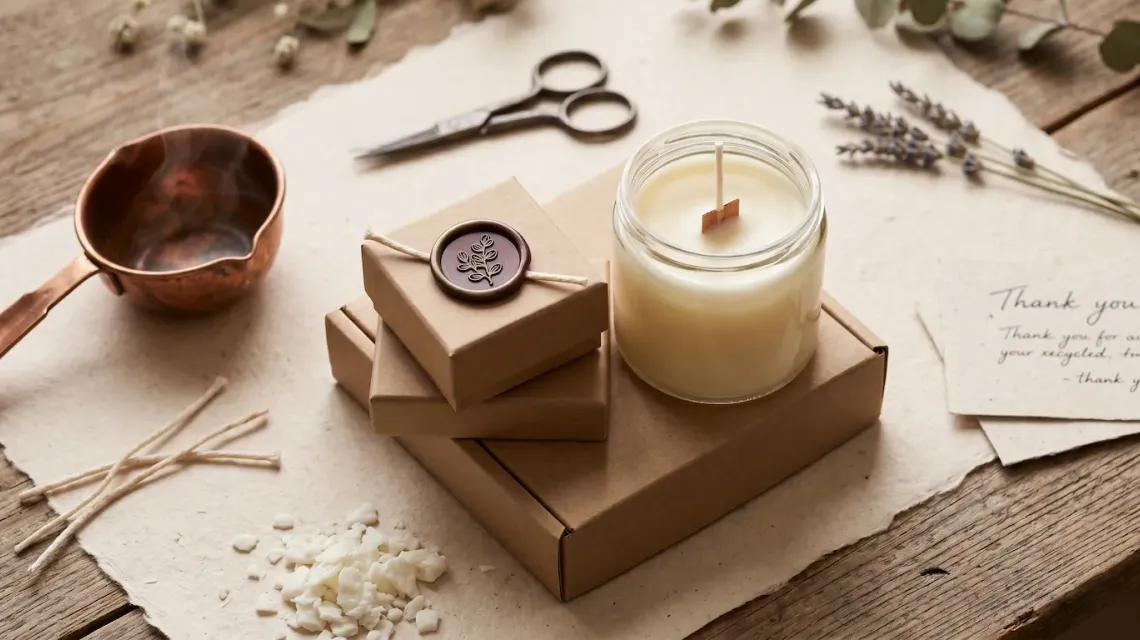
- Add a wax seal to the tissue paper or inner envelope—it immediately becomes part of your physical visual identity
The product-photography rule: Use a white or cream-kraft background, natural window light and a single prop such as a dried sprig, a stone or a book. Repeated at every photo session, this simple formula creates a visually consistent Instagram profile with minimal effort.
Free Tools You Can Start Using Today
You do not need Adobe Illustrator or an expensive design-tool subscription. Free, accessible and capable tools are available for creating everything a small handmade brand needs in its early stages.
Create labels, thank-you cards, Instagram templates and branding materials. Canva offers hundreds of templates that you can adapt to your palette and fonts.
A simple and fast color-palette generator. Press the Space key to generate combinations until you find one that represents your brand, then save the hex code for each color.
More than 1,000 free fonts are available for commercial use. Look for tested combinations in the “Popular pairings” section beside a font.
A highly useful tool for visual research. Create separate boards for your color palette, packaging inspiration, photography style and the brand’s overall aesthetic.
The First Step: Small, Intentional and Consistent
Visual identity is not built in a single day, and it does not need to be perfect from the beginning. It develops through small, intentional decisions repeated until they become second nature. Every label placed on a product, every wax seal applied and every photograph posted adds another building block.
A small handmade brand’s greatest advantage over an industrial one is its authenticity—the fact that a real person stands behind it, with a distinctive aesthetic, a personal story and hands that made every product. Visual identity is how that authenticity becomes visible and recognizable.
Do not wait for a perfect logo, a complete website or a professional photo shoot. Choose three colors. Choose two fonts. Print a label. Add a seal. Photograph the product against a clean background. Repeat.
In six months, you will look back and see a brand—not a collection of random decisions, but an identity you built with your own hands, step by step.
Everything You Need for a Visually Consistent Brand
Explore the Solideea catalog for kraft labels, wax-seal sets, stamps and branding accessories—materials selected especially for small makers who want to build a recognizable, authentic and beautiful brand.
Explore the Solideea Catalog →
Leave a Comment