



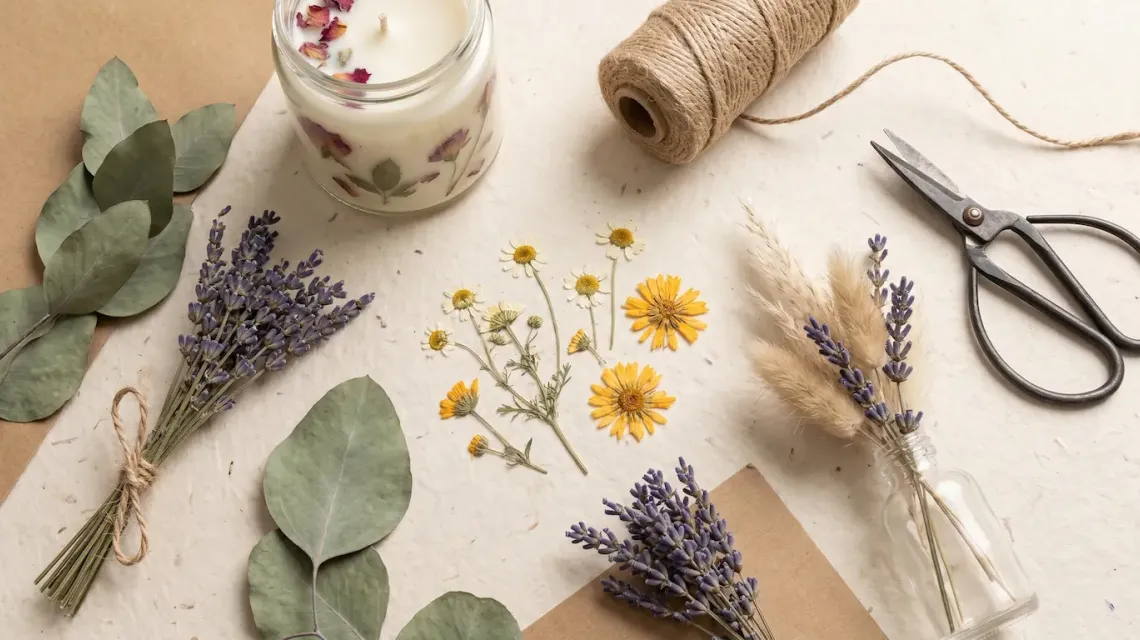
Dried botanicals in your creations: usage guide, combinations and sources of inspiration
Lavender, eucalyptus, pressed flowers — more than decoration. A practical guide to integrating them into candles, packaging and decorations with beautiful, long-lasting results.
- Why dried botanicals are more than a trend
- Plant guide — what each one does and where it fits best
- In candles — techniques and safety rules
- In packaging — the detail that transforms a parcel
- In decorations and soaps — arrangements and visual integration
- Seasonal combinations — what works with what
- How to preserve dried botanicals over time
A small eucalyptus sprig tucked under jute twine is not just decoration. It is a sign that someone paid attention to that parcel — and people feel that before they even open anything.
Dried botanicals have found their place in artisan workshops around the world — and not by accident. They bring something no synthetic material can replicate: real texture, the beautiful imperfection of nature and an organic aesthetic that the eye instinctively recognises as authentic.
For an artisan producer, dried botanicals are among the most versatile creative tools available. You can use them in candles, packaging, decorations, arrangements for bottles or jars, and decorated soaps — and every time, the effect is different and personal.
This guide explains, in practical terms, everything you need to know: what each plant does, how to integrate it into different types of projects, which combinations work best by season and how to keep your botanical stock in optimal condition.
Plant guide — what each one does and where it fits best
Not all dried botanicals behave the same way. Some are robust and withstand heat, while others are fragile and work only as surface decoration. Before starting any project, it is important to understand the material you are working with.
One of the most loved plants in handmade work. Long stems, a purple-grey colour and a delicate look. It works well in packaging, as surface decoration for soaps and in bottle arrangements. In candles, use it with caution — only on the outside or in layers protected by wax.
Oval, grey-green leaves with a strong visual presence. Very durable, keeping its shape and colour for years. Excellent in packaging (under twine), in botanical arrangements and on the outer surface of glass candle jars.
Chamomile, calendula, wildflowers — they add colour and delicacy. Fragile, but visually striking. Ideal as surface decoration on soaps, inside packaging and for candles in glass jars (attached to the inner wall before the wax is poured).
Volume, feathery texture and a dramatic look. Perfect for arrangements in vases and bottles, wall decorations and parcels that need to look generous. They should not be used in candles or soaps.
Cinnamon sticks, star anise, poppy pods — they add a textural dimension and a warm aesthetic specific to the cold season. Exceptional in autumn-winter arrangements and in decorations for pillar candles.
Classic, romantic and instantly recognisable. In dusty pink or dried burgundy tones, they add warmth and femininity. Use them inside packaging, on the surface of soaps and as decoration in candle jars.
In candles — techniques and safety rules
Candles with botanical elements are among the most photographed handmade products — and among those that require the greatest attention to safety. Dried botanicals are flammable materials, so integrating them into a candle must be done methodically, not at random.
Two main methods
-
1Botanicals attached to the inner wall of the jarBefore pouring the wax, attach the dried flowers or eucalyptus leaves to the inner wall of the glass jar with a little melted wax applied using a brush. Once the wax has hardened, carefully pour the liquid wax without disturbing the arrangement. The botanicals remain visible through the glass, but are protected by the wax — they do not come into direct contact with the flame.
-
2Botanicals on the outer surface of the candleAfter the candle has fully solidified, you can decorate the outside of the jar or the pillar candle with botanicals secured with jute twine, ribbon or wax. This method is the safest and cleanest visually, and it eliminates the risk of ignition because the decorative elements remain on the outside.
Essential safety rule: No botanical element should be embedded in the wax in such a way that it reaches the wick's burning zone. The side areas and the bottom of the jar are safe; the centre of the candle, around the wick, must always remain free of any flammable material. Always mention this rule on your product label as well.
Recommended plants for candles
Presentation tip: Candles in clear glass jars with botanicals attached to the inner wall are among the most photographed handmade products on Pinterest and Instagram. Make sure the botanical arrangement is visible from the outside and photograph the unlit candle in natural light, on a white or kraft background.
In packaging — the detail that transforms a parcel
This may be the simplest and most accessible way to use dried botanicals — and one of the most visually impactful. A small eucalyptus sprig or a few lavender stems tucked under jute twine instantly transforms an ordinary package into a moment of surprise.
Dried botanicals used in packaging have no safety restrictions — you have complete freedom to experiment with plants, textures and volume. The only criteria are aesthetics and transport resistance.
Transport-resistance rule: Always secure the botanicals with twine, not adhesive. Adhesive can fail in humidity or heat. Tightly tied jute twine keeps the arrangement intact throughout delivery and looks more authentic than any glued alternative.
In decorations and soaps — arrangements and visual integration
Botanical arrangements in bottles and jars
Small glass bottles with dried botanicals are among the simplest and most requested handmade decorative products. They require no special equipment, are quick to make and have a look that can scale easily from a 15 lei product to an 80 lei product, depending on the complexity of the arrangement and the quality of the glass.
-
1Choose the bottle shape and size according to the plantsNarrow-neck bottles work perfectly for long lavender stems or slim stalks. Wide jars allow mixed arrangements with volume. Clear cylindrical bottles look best with colourful botanicals (calendula, wildflowers) that need to remain visible.
-
2Build the arrangement from large to smallStart with the largest and most structural elements (eucalyptus, pampas grass, long stems), then add the medium elements (lavender stems, small branches) and finish with the small details (petals, pressed flowers, decorative seeds). This order creates visual depth.
-
3Secure and finishAdd decorative sand, small pebbles or granulated wax at the base to anchor the arrangement. Tie the neck of the bottle with jute twine or natural cotton and add a small tag with information about the plants or a short story behind the arrangement.
Botanicals in handmade soaps
Soaps decorated with botanicals are visually exceptional products — but they require care when choosing the plants, because not all withstand contact with a wet soap base.
- On the surface of the soap — press the flowers immediately after pouring, while the surface is still malleable; lavender, chamomile and rose petals perform very well
- In the mould, as base decoration — place the botanicals in the mould before pouring; they will appear on the surface of the finished soap, perfectly integrated
- Calendula — is among the most resistant plants during the saponification process — it keeps its yellow-orange colour even after several months
- Avoid plants with strong volatile oils — in large quantities — they can affect the hardening process of the melt-and-pour soap base
Botanicals on the surface of soap may turn brown or darken over time, especially when exposed to humidity. This is a natural process. Inform your customers about this aspect and present it as a feature of natural authenticity, not as a defect.
Seasonal combinations — what works with what
One of the strongest creative strategies is to build seasonal product collections around botanical combinations. Customers respond strongly to seasonal associations — they evoke memories, emotions and buying desires that are much more powerful than those generated by products without a time-based context.
Pressed wildflowers, chamomile, dried cherry blossom petals, mimosa branches. Colours: pale yellow, dusty pink, creamy white. A delicate, airy aesthetic full of light.
Lavender, calendula, elderflowers, green eucalyptus. Colours: purple, intense yellow, fresh green, white. A vivid Mediterranean aesthetic with solar energy.
Cinnamon, star anise, dried leaves, poppy pods, dried eucalyptus. Colours: ochre, warm brown, burgundy, dark green. A warm, spicy aesthetic of the harvest season.
Dried conifer branches, decorative cotton, silver eucalyptus, white lavender. Colours: white, silver, dark green, natural kraft. A minimalist Scandinavian aesthetic with intimate warmth.
Collection strategy: Each season, build a set of 3-5 products that share the same botanicals and the same colour palette. The candle, the botanical arrangement and the gift packaging from the same season will look like a coherent collection — not scattered products — and will encourage customers to buy sets, not individual items.
How to preserve dried botanicals over time
An investment in quality dried botanicals is worth protecting. With proper storage, most dried plants keep their colour, shape and texture for 1-3 years — sometimes even longer.
- Away from direct light — UV light quickly fades botanicals; keep them in closed boxes or in spaces without direct sun exposure
- Low humidity — humidity is the greatest enemy of dried botanicals; avoid storing them in bathrooms, kitchens or spaces with frequent condensation
- Vertical position or hanging — flowers and branches keep their shape best when stored vertically, with the heads up, or hanging with the stems upward
- Cardboard boxes, not plastic bags — cardboard allows minimal airflow that prevents mould; sealed plastic can create condensation and damage the plants
- Clear labelling — note the plant type and purchase date on each box; you will always know what you have and how fresh your stock is
Dried botanicals are not perfect, and they do not need to be. Their natural imperfection — a slightly curved petal, a leaf with darkened edges — is part of their character. But beyond these natural imperfections, the quality must remain good enough to represent your brand with dignity.
Find the perfect botanicals for your projects
Explore the Solideea catalogue for dried lavender, eucalyptus, pressed flowers and a varied selection of natural botanicals — carefully chosen for makers who know that details make the difference.
Discover Solideea botanicals →
Leave a Comment