



Secrets of a Memorable Unboxing Experience for Your Customers
The only moment in the sales process with a 100% open rate. Do not waste it.
A package can be forgotten. A moment cannot. The difference lies in how you choose to wrap what you created with your own hands.
Every online purchase involves a paradox: the customer pays before touching the product. They place their trust in photographs, descriptions and other people’s reviews. The moment the package reaches their hands is the only stage in the entire journey when the open rate is 100%. Every box you send will be opened. Every package will be touched, felt and examined.
The question is not whether the customer will open the package. The question is what they will feel when they do. This is the moment when an ordinary buyer becomes a fan of your brand—or does not. For a small handmade business, that difference can be worth more than any marketing campaign.
The unboxing experience does not begin when the customer opens the box. It begins when the package arrives at their door—with its texture, its weight and the first visual detail they notice. From there, every layer they unwrap is another opportunity to say: “I put care into this. You mattered.”
The visual elements that make the difference
You do not need a large budget to create a memorable unboxing experience. You need intention and a few carefully chosen materials. These are the elements that turn an ordinary package into a moment of joy.
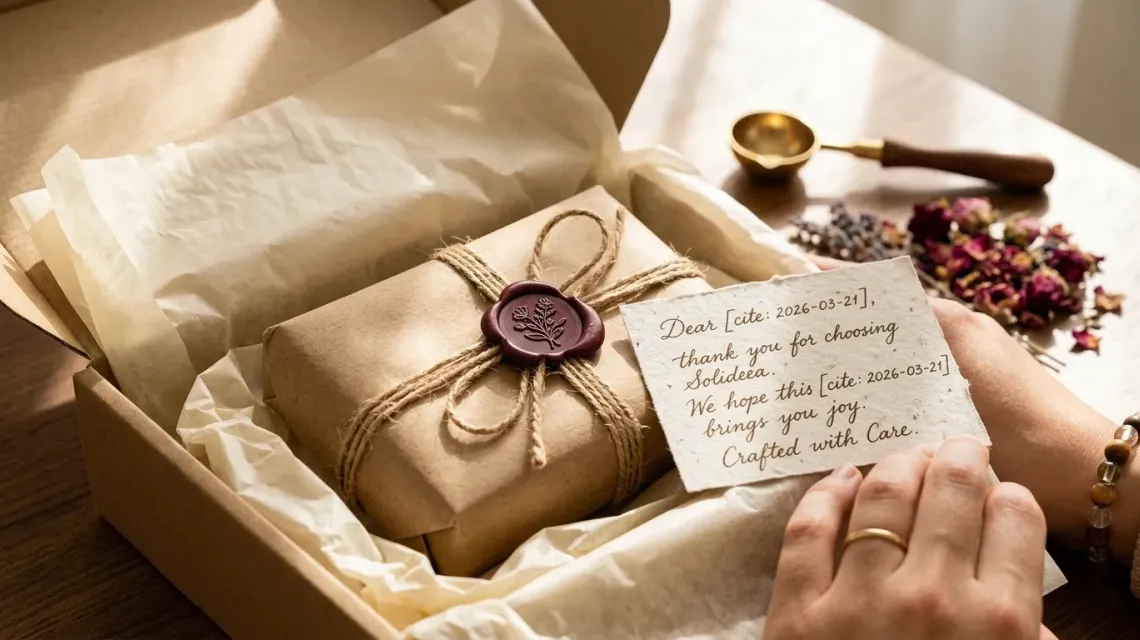
Tissue paper—the layer of mystery
Before a customer sees the product, they imagine it. Tissue paper is the layer that delays the reveal in the most pleasant way. It rustles softly when touched, covers the product delicately and makes opening the package feel like unwrapping a gift rather than simply unpacking an online order.
- Choose neutral tones—white, cream and sage green—that suit any product and complement the kraft aesthetic
- Use two or three overlapping sheets for generous volume and a richer visual effect
- Fold the edges carefully—this detail tells the customer that you worked with intention rather than in a rush
- Secure the paper with a round logo sticker or a wax seal
Why it works: The human brain associates successive layers of wrapping with gifts received in childhood. Tissue paper activates that emotional memory and connects it with your brand.
Wax seals—the noble ritual of opening
A wax seal applied to tissue paper or to the envelope containing a thank-you card turns a simple gesture into a ritual. It is a detail with historical roots: for centuries, seals marked important correspondence, valuable documents and things that mattered.
Applied to handmade gifts, the wax seal communicates one thing: “This package was prepared by a real person who cares about their work.” It is personal, unique and human.
Dark brown, creamy white, matte gold or black all work beautifully with kraft cardboard and a cohesive handmade aesthetic. Avoid bright colors that disrupt the mood.
Initials, a floral motif, a simple geometric shape or a leaf—any detail repeated across all your packages gradually becomes a recognizable visual signature.
Apply it to folded tissue paper, the envelope containing the thank-you note, an inner bag or even directly to the kraft box. Every placement reinforces the visual consistency of your brand.
The customer must “break” the seal to reach the product. This small act creates a sense of active participation: the package is not merely received, it is discovered.
The human element: a personal touch
Any visual element, however carefully chosen, can still feel impersonal without a human gesture behind it. The simplest, least expensive and most effective human touch you can add as a handmade producer is a handwritten thank-you note.
Why a handwritten note is worth more than any discount
A 10% discount coupon is forgotten as soon as the customer closes the email. A handwritten thank-you note is placed on a desk, photographed and shown to friends. Sometimes, it is kept.
This is not about perfect calligraphy or elaborate wording. It is about someone picking up a pen, thinking about the person who will receive the package and writing something genuine by hand. In a world where everything is automated, this gesture takes 30 seconds and can be as valuable as a customer-retention campaign.
Write the customer’s name, a sincere “thank you” and perhaps a sentence about the product they chose on a kraft tag or a small card. That is enough. You do not need more to turn the handmade gifts you send into memories.
-
1Use the customer’s first name“Dear Maria” or “Hello, Andrei” completely changes the tone of a message. It is the difference between impersonal communication and a genuine conversation.
-
2Mention the product they chose“I hope the eucalyptus candle brings a little calm to your home.” A specific sentence shows that you noticed the order instead of processing it mechanically.
-
3Sign with your real nameNot with the brand name—with your own name. “Warmly, Elena” feels much more personal than “The Solideea Team.” People buy from people, not from brands.
-
4Add a small surprise detailA sprig of dried lavender, a sticker with your logo or a small sample of another product—something unexpected, placed discreetly beneath the tissue paper. A surprise creates a story.
Avoid generic messages copied from templates. Customers immediately sense the difference between a genuine message and an automated one, even when both are handwritten. Authenticity cannot be imitated.
Customer retention through product packaging
A beautiful unboxing is not merely an aesthetic gesture. It is a business strategy with measurable effects. For a small handmade producer, those effects can make the difference between a business that survives and one that grows.
Reducing returns
Careful product packaging can significantly reduce returns—not because the product is different, but because the customer perceives it differently. A product packaged thoughtfully, well protected with tissue paper and showing no signs of haste appears to be of higher quality. Often, a customer who might have returned a carelessly packaged product decides to keep one that arrives beautifully presented.
User-generated content (UGC)
Every beautiful package you send is a potential Instagram, TikTok or Pinterest post. Your customers are your best brand ambassadors—but only when you give them something worth photographing.
A simple example: a customer receives a photogenic package, photographs it, posts it and tags the brand. The post reaches 200–500 people in their circle—people who may share the same buyer profile. This is free, authentic advertising with a persuasive power that paid advertising cannot easily replicate.
Unboxing is not a cost—it is an investment
Large retailers can offer lower prices, faster delivery and a wider range of products. But they cannot offer a handwritten note. They cannot offer a wax seal applied by a real person. They cannot offer the feeling that someone thought about you while preparing your order.
This is the opportunity that remains wide open to a small handmade producer—and one that large retailers can never completely close. Product packaging done with care is not a luxury, an optional expense or something to postpone until you “grow.” It is one of the tools that helps you grow.
Every carefully packed kraft box, every deliberately folded sheet of tissue paper and every wax seal applied by hand conveys a message the customer can feel, even when they cannot put it into words. It gives them a reason to return.
Start with your next order. Add a layer. Write a note. Include a dried sprig. Apply a seal. Your customer will notice. And they will not forget.
Turn every delivery into an experience
Explore the Solideea catalog for tissue paper, wax seal kits, natural twine and dried botanical elements—everything you need to turn every package into a memorable moment for your customer.
Explore the Solideea catalog →
Leave a Comment